Hiển thị các bài đăng có nhãn sheet piles. Hiển thị tất cả bài đăng

10/30/2011

HRC import prices in SE Asia dip on iron ore price plunge


Import prices of commercial quality 3-12mm thick hot rolled coil have fallen to $630-635/tonne CFR Vietnam. Some deals involving small volumes of SS400B HRC from China were concluded at these level last week, trading sources tell SBB. “There are also some buyers who are waiting for prices to fall to $620/t CFR or even lower to $600/t CFR,” a Vietnamese trader says. Chinese offers for this grade were heard at $640-650/t cfr a week ago. The slide in HRC prices is mainly attributed to the plunge in iron ore spot prices. Some stockists in Vietnam expect Chinese export prices to dip to $585-590/t fob, a local trader says.

Some market sources maintain that these low-priced offers are from speculators or stockists in China since offers from Chinese mills average $645-650/t CFR Vietnam. They say the fall in HRC prices is slowing down and that the market could improve by end-November. "The global economic outlook is better with the agreement to boost the euro-zone's bailout fund," a Vietnamese trader says. And the Chinese domestic market will improve after announced production cuts.

Offers of Korean-origin 2mm base SAE 1006 HRC have dropped to $680-685/t CFR Vietnam compared to $685-690/t CFR a week ago. Some Korean offers are heard at lower levels of $665-670/t CFR
. “Nobody is buying, so they have to lower prices,” a regional trader says. A Taiwanese re-roller is heard, but not confirmed, to have offered SAE 1006 2mm HRC at $670/t CFR Vietnam–

Some 20,000 tonnes of Japanese-origin SAE 1006 2mm HRC for December shipment was sold to two customers at $690/t CFR two weeks ago.


SE Asian billet importers stay away in bearish market


Sentiment for imported billet continues to be weak in Southeast Asia as iron ore and scrap spot price plummet across the region. A booking of CIS Black Sea billet is heard booked last week at $630/t CFR Thailand. In Philippines, Russian-origin billet was offered at $630/t CFR Philippines and for Korean-origin billet at $640-645/t CFR, which is $5-10/t lower than a week ago.

Traders are generally believed to be making these low-priced offers. “Billet makers in Korea are stepping back and not making fresh offers,” a Korean trader tells SBB.

Vietnamese induction furnace mills are looking to export billet today at $620-630/t fob, local traders tell SBB. “The billet producers are using high-priced scrap so they face difficulties in lowering export prices,” trader in Ho Chi Minh City tells SBB. "Production costs are not competitive," another says. ""I don't think that there are any deals," he adds. An offer of induction furnace billet from Vietnam is heard at $645/t CFR Thailand. Freight within the region is estimated at $20-25/t.

Buying interest is very weak because of fears of offer prices falling further. Regional rebar markets are sluggish. As long as scrap prices continue to tumble, the billet import market in the region will continue to be under pressure, SBB is told.


Vina Kyoei gets approval for new billet plant, bar mill


The Vietnamese government has approved plans by Vina Kyoei Steel to build a meltshop, billet caster and rolling facilities to nearly double the mill’s capacity to about 900,000 tonnes/year when the expansion is completed around 2013.

The new meltshop will host a 90-tonne AC furnace and a billet caster capable of producing 130-150mmsquare billets to 6 metre lengths, and a 500,000 t/y rolling mill. Located at Vung Tau in southern Vietnam,the mill is currently operating at full capacity at 400,000 t/y producing rebars and wire rods from imported and domestically-sourced billets.

Vina Kyoei is owned 45% by Japanese mini-mill Kyoei Steel, 40% by Vietnam Steel Corp, and 9% and 6% respectively by Japanese traders Mitsui and Marubeni-Itochu Steel.

“We have been planning a meltshop at Vina Kyoei to supply billet ourselves to improve competitiveness,”Kyoei spokesman tells SBB. To date, Kyoei has been supplying about 5,000-6,000 t/m of billet from its Osaka plant to Vina Kyoei. “Exports to Vina Kyoei will decrease but we have customers in Southeast Asia and also in Japan, so we will have no problem with losing Vina Kyoei as a billet consumer,” he said.

Vina Kyoei has also been importing billet from other sources and procuring domestically-produced lower priced semis.

With the new facilities Vina Kyoei will start producing angles too, though the company has not decided production volume. Last month it began producing screw bars with technologies transferred from Kyoei.


Source: SBB

8/10/2011

Vietnamese construction steel sales up 21% m-o-m in July


Sales volume of construction long products in Vietnam in July reached 359,000 tonnes, an increase of 20.5% from the previous month but down 32.4% year-on-year, according to the Vietnam Steel Association (VSA). Production of longs in June at 308,000 t was down by 11.2% m-o-m and lower by 29.1% y-o-y.

Cumulative sales of longs during the first seven months of this year reached 2.78m t, up 3.2% compared with January-July 2010. Production rose to 2.89m t, an increase of 7.7% over the corresponding period last year.

“Steel sales slowed down in June,” VSA vice-chairman and general-secretary Dinh Huy Tam tells Steel Business Briefing with reference to sales dipping to just under 300,000 t for that month. He tells SBB that steel demand in August will be adversely affected by a slowdown in construction activity. This is due to the rainy season as well as the Hungry Ghost Festival taking place this month.

The tight monetary and fiscal policies being implemented in Vietnam to stem high inflation continues to have a negative impact on steel consumption, says Tam. Inflation during the first seven months of this year reached 14.6% and bank borrowing interest rates are prevailing at more than 20% per annum.

The VSA tracks data from its member steel mills that together contribute around 85% of Vietnam's long steel production.


Korean domestic H-beam prices firm slightly.


Korean spot market prices for H-beams produced by domestic mills have climbed to KRW 970,000r - 990,000/t ($892-910/t) for SS400 grade ‘junior’ beams this week, up by KRW 20,000-30,000/t ($18-27/t) from late July.

The climb reflects efforts by local dealers to pass on their higher input costs to end-users in tandem with rising prices from the two producers Hyundai Steel and Dongkuk Steel Mill.

In late July, Hyundai announced higher sales prices for H-beams and sections starting from 1 August of KRW 30,000-40,000/t depending on product and size, as SBB reported. With an upturn in market sentiment, spot prices for China-origin H-beams of similar size have also seen a small rise over the past two weeks of KRW 10,000-20,000/t to reach KRW 880,000-900,000/t ($809-827/t).

Buying activity among end-users remains thin for the moment, but industry sources believe H-beat prices will remain firm for the rest of this half. They cite several factors including higher input costs for mill from new electricity charges, output constraints during July-August due to summer maintenance, and expected better construction sector demand from autumn, as SBB has reported.

Meanwhile, Korea’s total H-beam output in this year’s first half stood at 1.53mt, up 4% from 1.47mt in H1 2010, according to Korea Iron & Steel Association data. Within the total, exports reached 668,200 t, up 6.1% y-o-y. But the total output for sections including angles and channels in H1 declined by 5.1% y-o-y to 2.08mt.

Source: SBB

8/01/2011

Các loại tiết diện Cọc Ván Thép

Cọc ván thép được sử dụng đầu tiên từ những năm đầu của thế kỷ XX, các tấm Cọc ván thép đã phát triển thành một trong những vật liệu linh hoạt nhất trong kho vật liệu kỹ thuật xây dựng dân dụng. Với kỹ thuật sản xuất thép hiện đại và cải tiến của công nghệ hiện đại, Cọc ván thép được chế tạo với nhiều tính năng mạnh mẽ vượt trội, nhẹ hơn và linh hoạt hơn trong thi công.

Sản xuất cán nóng cọc ván thép
Các cải thiện đã diễn ra không chỉ trong quá trình sản xuất cọc ván thép mà còn trong các kỹ thuật lắp đặt - thi công. Trong bài này chúng tôi sẽ giới thiệu đến các chủng loại khác nhau của cọc ván thép tấm hay là các tiết diện của cọc như thường được gọi. Chúng tôi sẽ đề cập chi tiết về thi công trong một bài đăng sớm nhất.

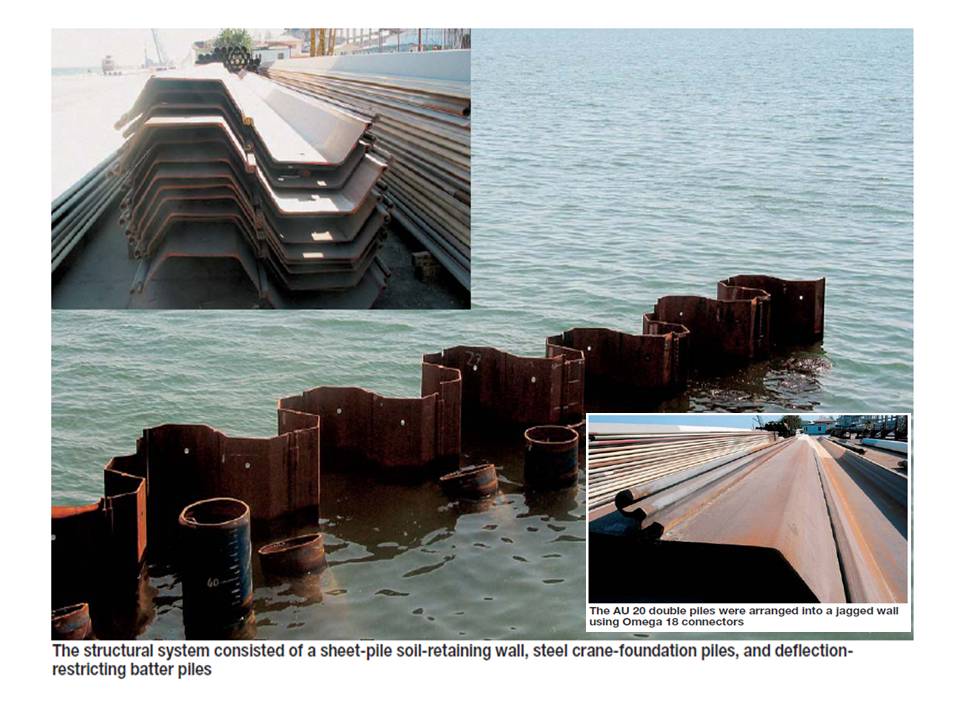
Ngày nay cọc ván thép phát triển thành các tiết diện hình học khác nhau. Bắt đầu từ tiết diện cọc tấm chữ U là loại cừ ván thép phổ biến nhất, hiện nay còn có tiết diện hình chữ Z, cọc tiết diện phẳng hoặc kiểu Omega. Cọc phẳng hay straight web được sử dụng để hình thành các giếng kín (cofferdams)cỡ lớn.Linh động được sử dụng trong nhiều dự án quy mô lớn trong các công trình kỹ thuật dân dụng.

Bất kể các loại cọc ván thép nào, vẫn chủ yếu là được sản xuất với công nghệ cán nóng và có một số chủng loại được cán nguội. Sự khác biệt là quá trình sản xuất cán nguôi diễn ra ở nhiệt độ phòng, với vật liệu thép chạy qua hệ thống các trục với con lăn định hình, trong khi thép hình cán nóng được hình thành ở nhiệt độ cao. Từ công nghệ tạo hình nguội thép tạo ra các chủng loại cừ thép mỏng hơn rất nhiều so với thép cán nóng.

Cán nguội (cold rolling) cọc ván thép
Như có thể thấy trong bản vẽ kèm theo, kích thước của cọc ván thép được định dạng theo các thông số b, h, e. Trừ những cọc ván dạng tấm phẳng. Các thông số này đại diện cho bản rộng của tiết diện, Chiều cao của tiết diện, và độ dày mỏng bản bụng và bản cánh. Với cọc dạng tấm phẳng, chiều rộng được ký hiệu là L và W. chiều cao hay độ dày được ký hiệu là e. Các loại kích thước rộng bản, dày mỏng khác nhau tạo nên các loại cọc ván thép có khả năng chịu áp lực, tải trọng khác nhau.

Nếu bạn chú ý vào chiều dày tiết diện, ví dụ cọc van tiết diện chữ U, bạn sẽ thấy rằng độ dày bản bụng là dày hơn so với chiều dầy bản cánh. Bản cánh được thiết kế mỏng hơn do sự làm việc của bản cánh là thứ yếu trong kết cấu cọc và giúp cọ nhẹ hơn cũng như dễ dàng trong thi công. Thiết kế đã tính toán trước độ dày tối ưu của bản cánh và bản bụng trước khi các cọc ván được sản xuất theo một quy cách nhất định. Cả hai độ dày ảnh hưởng đến khả năng chịu lực - kháng uốn của các tấm cọc. Một lần nữa, nếu bạn nghiên cứu các loại tiết diện cọc ván thép, khả năng chịu lực được kỹ thuật hóa bằng các con số đại diện cho "Mô men Quán tính - Moment of Inertia " và "Mô đun tiết diện - Section Modulus".


Cọc ván thép tiết diện chữ U

Cọc ván thép tiết diện chữ U, với độ sâu và chiều rộng cũng như độ dày tiết diện. Chiều sâu tiết diện (hay chiều cao của cả tường cừ) sẽ gấp hai lần một cọc đơn khi được cài đặt vào nhau.


Cọc ván thép tiết diện chữ Z
Cọc ván thép tiết diện chữ Z, với độ sâu và chiều rộng cũng như độ dày tiết diện có thể giống hoặc khác nhau. Chiều sâu tiết diện (hay chiều cao của cả tường cừ) không thay đổi so với một cọc đơn khi được cài đặt vào nhau. Sau khi cài đặt hai cây cọc đơn, ta có một cọc tiết diện tổng thể như cọc chữ U.


Cọc ván thép tiết diện phẳng - Straight web
Cọc dạng tấm phẳng có chiều sâu nông, chủ yếu là khả năng kết hợp và chịu lực kéo cao giữa các tiết diện dơn. Về cơ bản một tấm cọc dạng phẳng bằng thép với các tính năng lồng vào nhau ở cả hai bên, tạo nên các tổ hợp chịu lực lớn là tường chắn không trọng lực cho các khu nước sâu hay địa chất rất yếu.


Cọc ván thép tiết diện Ω (Omega)

Với cọc tiết diện Ω, chúng có khả năng kết hợp và khả nặng hạ cọc sát vào tường của các địa hình thi công hiện hữu bị hạn chế. Các cọc Omega có lợi thế trong lượng nhẹ cho các kết cấu vĩnh cữu với chi phí hợp lý.